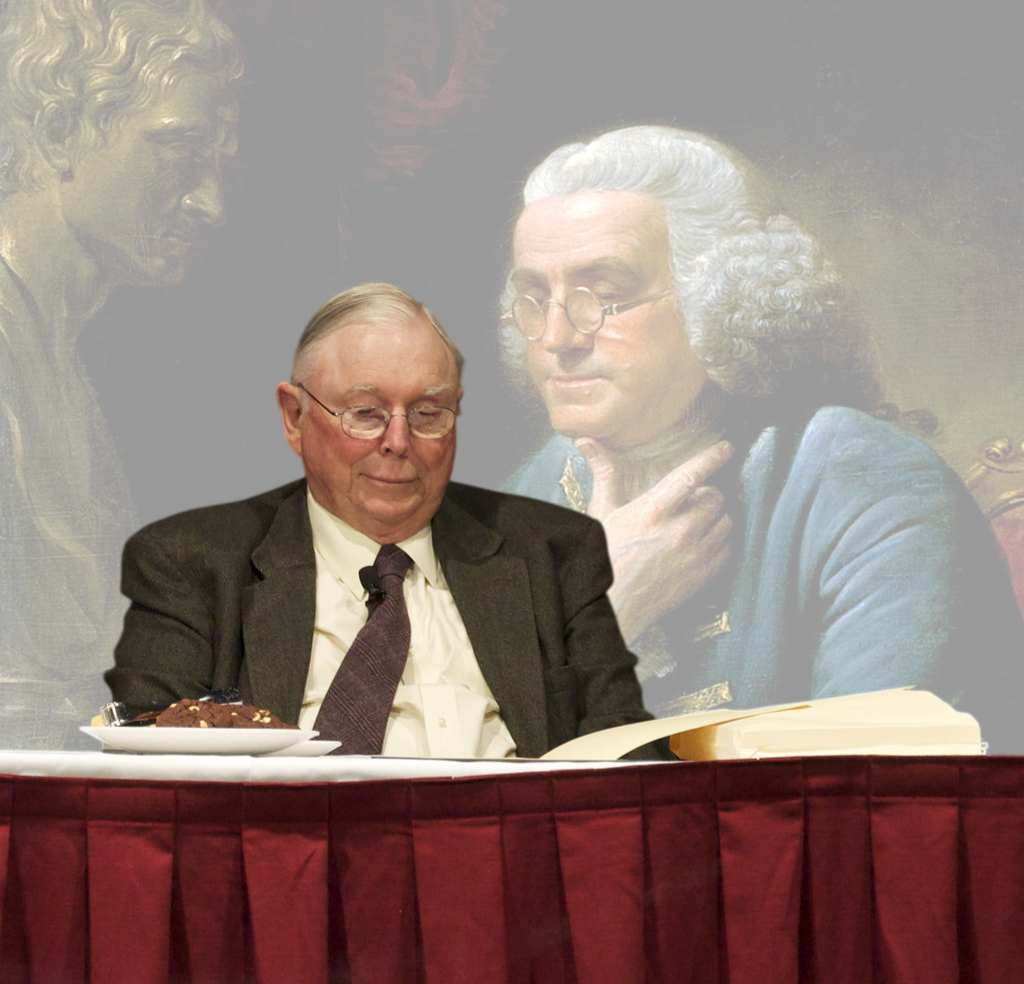
I have been criticized no-end by Essay Club for rambling and going on unresolved tangents. Let me warn ye then that I can feel it happening and I haven’t even started writing yet. This week we are talking about a clump of inter-linked symbols in my noggin which can all be linked to Charles T. Munger. To inb4 a fresh wave of these complaints, let me tell you what the rest of this essay is about. A list:
- Charlie Munger
- Munger and Buffetts Investment Philosophy
- Elements of his polymathy
Now before we get started: is he a pedophile? No, probably not. He was friends with Bill Gates who was friends with you-know-who. And he was a billionaire which seems to affect the statistics on this grave, but from what I can tell this is where the evidence ends.
I guess it will be hundreds of years before this man becomes actual history and can be judged properly accordingly, but to my eyes he seems like a true role model for learnedness and polymathy. Hero would be a stretch, but I must thank YouTube recommendation algorithm for giving me this man who turned out to be the perfect antithesis and antidote to my previous male-role-model: Conor McGregor. In 2019 I started listening to Berkshire Hathaway annual meeting Q&A sessions to bore myself to sleep as I got accustomed to living in a dingy student house. This quickly became counteractive as although most of the questions and answers where adequately boring, every few minutes Charlie would speak some adage / maxim that sparked my eyes wide open and lighted every neuron I didn’t know I had…..
Charlie Whomst?
Charles T. Munger was born in 1924 and died in 2023. At 19 he was drafted into the US Air-force and until being discharge in 1946 he served as a meteorologist. Via the GI Bill, Charlie studied Law at Harvard, joined a law firm, and in the 60’s founded his own firm specializing in real estate. Around this time he was introduced to Warren Buffett and began their life long mutually-intellectually-challenging relationship. Buffett and he had a similar investment strategy in the beginning, commonly call cigar-butt investing; where large counts of stocks (or other assets) are sifted through in search of companies with ‘one last puff’ left in them. This would often mean buying a business for £10 where said business owed lets say a warehouse worth £20. But, through the 60’s Mungers general approach shifted away from any old cheap scraper to concern with high quality businesses at fair prices. And Buffett was persuaded to join suit.
Investment components
Discounted Future Cash Flows
As in all things the measure of a businesses ‘quality’ is multifaceted; reputation, financial health, staff skill, etc. And these are all considered when deriving a ‘fair price’, but the first step is get the ‘intrinsic value’, which comes from the following formula:
$$ V = \sum_{t=1}^{\infty} \frac{CF_t}{(1+r)^t} $$V is the the intrinsic value of the business we are assessing t is our time step, this goes up by 1 (year) as the forumal iterates CF is the free cash flow (a term you may wish to Goog) r is the discount factor
This is called the discounted future cash flow formula and it basically asks the following question: what will be the sum of this businesses yearly free cash flow if they keep trading until the universe ends? But there is a twist. Because a of inflation a dollar today is only worth 90-something cents this time next year, we must discount each years cash flow by some factor, ‘r’.
The Intelligent Investor
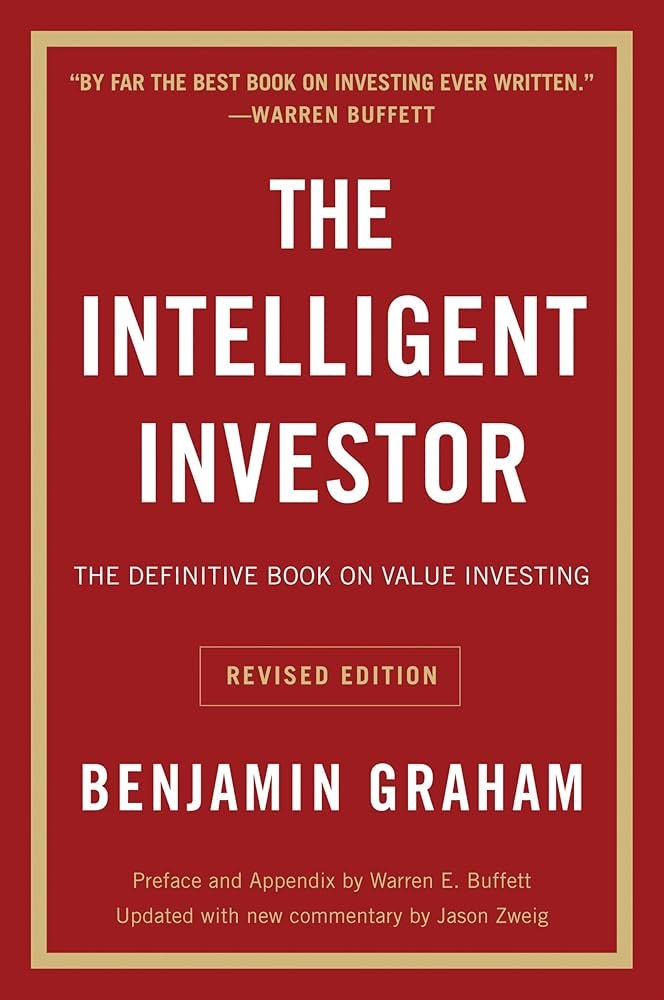
The rest of Buffett and Mungers investment stratagem comes from chapters 8 and 20 of The Intelligent Investor - a ‘best-selling’ book on value investing by Buffetts early mentor Benjamin Graham.
Chapter 8 anthropomorphises the markets as a schizophrenic that constantly offers to buy and sell your house / land and his on a daily basis. He shouts “I’ll give you £100 for you house, or you can buy mine for £1000?” every day, and you may take or leave his offers. Well if you think your house is only worth £45 then you might want to actually take him up on his offer today. And if you value his property at £1200 then perhaps you would want to buy his too? However, chapter 20 talks about the margin of safety in an investment, that is in effect asking ‘how wrong could I be?’. In our example, his house is available at £1000 and we think it is truely / intrinsically worth £1200 but if we have a personal rule as total noobs at investing that all our investments must have a 50% margin of safety, then we wouldn’t go for this deal because although it seems like we would make money, we cannot trust the market to correct by 20%.
 Even if you are not interested in picking individual investments, there a profound truths to be unveiled in coming to an understanding of the concepts mentioned here. And in the opinion of yours truly, they are so important that they should be taught in school. The DCF formula alone opens the door to understanding macro-economics, personal finance, risk, and I would argue a it supplements well all manor of other topics to include political philosophy, reinforcement learning, personal philosophy.
The discount rate r is something to consider, often the US 10-Year Treasure Bill yield is used here. That is to say, the baseline against which you should measure the performance of an investment is lending the US treasurey your money for 10 years. (Why not the stock market you ask, because it isn’t stable / risk free. We use the stock market to compare how well we are doing compaired to easier investment options).
The Wisdom
Charlies investing success (A CAGR of 24% 1962-1975, then 19.8% with Berkshire 1965-2023) was extraordinary, it left him with tres comas when we clocked out, even after a lot of philanthropy. But if having a billion dollars made you hero materal, one would soon reach ones Dunbar’s number with a full roster of serpents. Nay! What made Charlie Munger special was his worldy wisdom which extended far beyond money making, and his concise and highly effective way of distributing it.
Though he never wrote a book entirely, he did in 2005 sanction the publication of 11 talks he gave through out the later half of his life at various awards and honorary events. This book is called Poor Charlies Almanac, which is doubtless an ode to the title of his role-models autobiography — ‘Poor Richards Almanac’ by Benjamin Franklin. 10 of the talks therein are titled such as ‘A Lesson On Elementary, Worldy Wisdom’, ‘The Great Financial Scandal of 2003’, ‘Academic Economics’, ‘Practical Thought about Practical Thought?’, and are all worth reading along with the Revisited section that he wrote on post hoc for the book. Talk 11 however, as far as his literary work goes is his magnum opus. At just 67 pages in fairly loose print, it manages to entirely dismantle and reconstruct a significant portion of modern psychology. Titled ‘The Psychology of Human Misjudgment’ it does much to conglomerate the message of each of his other talks and often notions from other mediums by setting out 25 tendencies. These are as follows:
- Reward and Punishment Super-response Tendency
- Liking/Loving Tendency
- Disliking/Hating Tendency
- Doubt-Avoidance Tendency
- Inconsistency-Avoidance Tendency
- Curiosity Tendency
- Kantian Fairness Tendency
- Envy/Jealousy Tendency
- Reciprocation Tendency
- Influence-from-Mere-Association Tendency
- Simple, Pain-Avoiding Psychological Denial
- Excessive Self-Regard Tendency
- Overoptimism Tendency
- Deprival-Superreaction Tendency
- Social-Proof Tendency
- Contrast-Misreaction Tendency
- Stress-Influence Tendency
- Availability-Misweighing Tendency
- Use-It-or-Lose-It Tendency
- Drug-Misinfluence Tendency
- Senescence-Misinfluence Tendency
- Authority-Misinfluence Tendency
- Twaddle Tendency
- Reason-Respecting Tendency
- Lollapalooza Tendency (the tendency to get extreme consequences from a combination of multiple tendencies acting together)
I would encourage you to read the source material but let me say a few words on each of these: Reward / Punishment Superresponse Tendency: this tendency Charlie places at the beginning to stress the importance of incentive in driving behavior. This is explained like most of his other explanations via a string of references such a mention Mark Twain’s cat, who sat on a hot stove, then never sat on a stove again, hot or cold — interwoven with personally lived anecdotes about such concepts as commission. Envy / Jealousy Tendency: we know what this is but I just wanted to note that Charlie considers it the envy the most powerful of the 7 sins, and no wonder that the Moses spoke of it so much. He speaks also of the words jealousy and tendency weren’t even present in the three psychology textbooks he owned. Finally; Lollapalooza Tendency is the what makes the rest interesting. This is the outcome of recursive and… dare I say… strange looping and reinforcing of the other tendency working together. That is, when the other tendencies push behavior in the same direction to some extreme ends; with such examples given as auctions, cults, financial bubbles, and those experiments where people are willing to shock people with electricity.
Post Script
Invert, always invert: an idiom from Jacobi. Meaning to always consider problems in reverse to how your instinct would have you do so; i.e. instead of ‘how can i make a live a long life’ consider the various answers to ‘how can I live a short life’ and then set about avoiding whatever you come up with; smoking, stress, obesity, etc. This principle was interwoven with an admiration for Charles Darwin who seems highly critical of his findings / discoveries in the name of saving himself from the embarrassment of being wrong.
Post Post-Script
I forgot to even mention his method overarching approach to… well I’m not really sure how to word it… understand the world around him (cringe, L, doesn’t do it justice). He speaks throughout the talks he gave about the importance of learning the ‘Big Ideas’ from many fields of study, and using them to form a ’latticework of mental models’ on which you may hang (i.e. digest) any new problem or experience you might come to. This is everything from evolution to compound interest to his psychological tendencies.
This has got to be the least coherent one so far. I’d like to come back to this and break it into several different posts that are less sprawling and maybe just link back to each other…